


Every third family encounters a situation where a student starts squinting when looking at the board, or brings a book too close to their face. Parents take their child to an ophthalmologist, and the diagnosis sounds alarming: myopia. But the most unpleasant thing is when after six months it turns out that the minus has increased by another diopter. Is it possible to stop this process or at least slow it down? Let's figure out which methods really work and what modern ophthalmology offers parents.
Why does myopia progress?
Childhood myopia rarely occurs suddenly – it is a gradual process associated with the growth of the eyeball. Normally, the eye grows with the child, but in myopia, it lengthens more than necessary. The image begins to focus not on the retina, but in front of it, and distant objects become blurry.
Myopia develops particularly actively between the ages of 6 and 15 – it is during this period that school workloads increase and time spent outdoors decreases. A child's eyes constantly work at close range: textbooks, notebooks, smartphones, tablets. Such intensive close-up visual work creates conditions for myopia progression.
Optical vision correction
The key condition for successful vision control in a child is strict adherence to the ophthalmologist's recommendations. If the specialist has prescribed glasses or contact lenses, they must be used on a permanent basis. Parents« concerns that optical correction supposedly »unlearns" the eyes to work independently have no scientific basis. On the contrary, adequate correction reduces visual strain and helps keep myopia progression under control.
Today, several proven methods of optical correction are used in pediatric ophthalmology:
- Correction with glasses and soft contact lenses remains a universal and reliable option, suitable for children of any age and degree of vision impairment.
- Myopia control contact lenses are daily disposable soft lenses with a special optical design. Their purpose is not only to provide a clear image but also to influence the mechanisms of eye growth, slowing down its elongation.
- Orthokeratology lenses They are used exclusively at night. These rigid gas permeable lenses temporarily change the shape of the cornea during sleep, allowing the child to see well during the day without glasses or lenses.
The orthokeratology method demonstrates high effectiveness in slowing the progression of myopia in children. According to clinical observations, wearing these lenses at night reduces the rate of increase in the anterior-posterior size of the eyeball in mild and moderate myopia.
Outdoor walks as a factor in protecting vision
Regular time spent outdoors in natural light is one of the simplest and most effective ways to prevent myopia. Under the influence of daylight, dopamine production is activated in the retina, which prevents excessive growth of the eyeball. A walk duration of at least two hours a day is considered optimal.
The form of activity is not important. It can be quiet walks, games in the yard, or the daily walk to school and back. What's important is regularity and spending enough time outdoors.
Rational organization of visual load
Following the rules of visual hygiene can significantly reduce eye strain and create favorable conditions for visual work.
- Lighting. The workspace should be evenly lit. The most comfortable lighting is considered to be a combination of overhead light and a table lamp with a power of 60-100 W, placed to the left for right-handed people. The light source should not create harsh shadows, glare, or shine directly into the eyes.
- Distance to objects. When reading or writing, the distance from your eyes to a book or notebook should be about 12–14 inches (30–35 cm). It is recommended to position a computer or laptop screen at a distance of 20–28 inches (50–70 cm), with its top edge slightly below eye level.
- Alternating work and rest. After every 30–40 minutes of visual concentration, take a 5–10 minute break. During this period, it is beneficial to shift your gaze to distant objects, look into the distance, or engage in light physical activity.
Eye exercises are a healthy habit
- Simple exercises help relieve fatigue and tension from the eye muscles. This is not a panacea for myopia, but a good addition to the main correction methods. Ask your child to slowly move their gaze up-down, left-right, make circular eye movements, and focus on both near and far objects.
Nutrition for eye health
A balanced diet supports the visual system from the inside. Include foods rich in vitamins A, C, E, and B group in your child's diet: sea fish, eggs, carrots, pumpkin, blueberries, greens, and nuts. These substances strengthen the retina, improve blood supply to the eyes, and protect them from oxidative stress.
Regular visits to the ophthalmologist
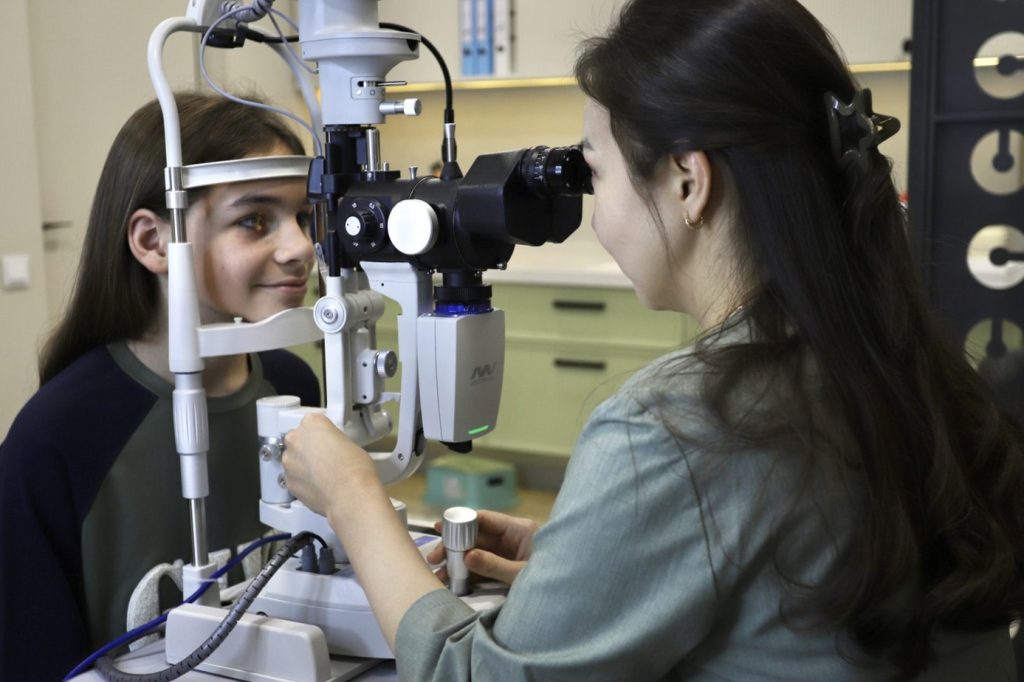
Children with myopia should visit an ophthalmologist at least twice a year, even if everything seems fine. Only regular check-ups allow for tracking changes over time and adjusting the treatment strategy promptly.
Completely stopping myopia in a child is difficult, but slowing its progression is quite realistic. A comprehensive approach yields the best results: proper optical correction, sufficient time spent outdoors, a well-organized learning process, and regular monitoring by a specialist.
Modern methods of myopia control—such as special contact lenses and orthokeratology—are particularly effective, as they not only correct vision but also influence the biomechanics of eye growth. Studies show that these methods can slow the progression of myopia by 50–60%.
Are you concerned about your child's eyesight? Specialists MediLens Optic clinics will help you find the optimal solution for myopia control. Modern diagnostics, an individual approach, and advanced correction methods – all for the eye health of your family. Book a consultation at phone or leave a request on the website, and our ophthalmologists will tell you in detail about the myopia control options specifically for your child.